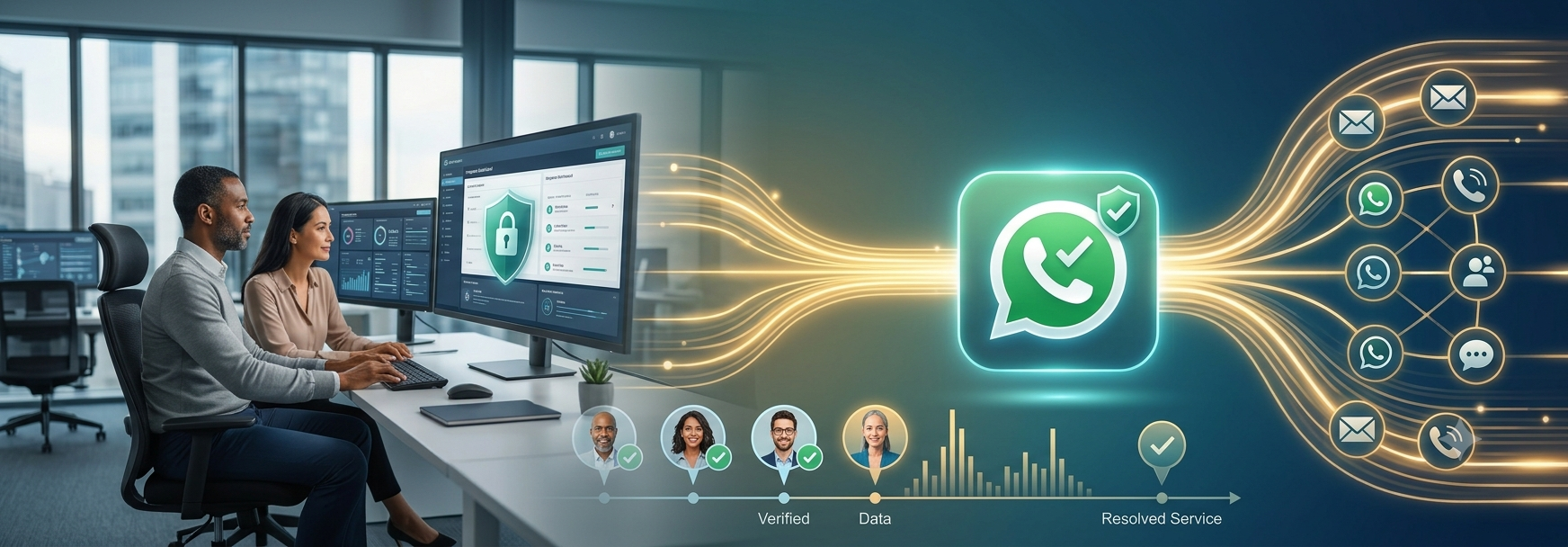
WhatsApp has over two billion active users. It is the default messaging application across large parts of Europe, the Middle East, Africa, Latin America, and South Asia — and a significant channel in markets where other messaging platforms dominate. For enterprises that serve customers in these regions, it is not a niche channel. It is where a significant share of their customers already spend time, conduct conversations, and expect to be able to reach organisations they do business with.
Why most WhatsApp enterprise implementations underdeliver
The most common pattern for enterprise WhatsApp deployment is one-way broadcast messaging — sending payment reminders, appointment confirmations, order updates, and promotional content to customers at scale. This is genuinely useful and produces measurable open rate improvements over email for the same content. But it treats WhatsApp as a better SMS rather than as a different kind of channel.
WhatsApp is a conversational channel. Customers who receive a message on WhatsApp expect to be able to reply to it. When they reply to a one-way broadcast from an enterprise and receive no response, the experience is worse than if the broadcast had been sent by SMS — because the WhatsApp context created an expectation of conversation that was then not fulfilled. The customer experience of an unmonitored WhatsApp broadcast is actively negative.
The second underdelivery pattern is deploying WhatsApp as an isolated channel — separate from the voice queue, separate from email, separate from chat — with its own team, its own tooling, and no connection to the customer history that exists in other channels. A customer who called yesterday and is messaging today reaches an agent who has no visibility into the call. The WhatsApp team operates in its own silo, replicating the broader fragmentation problem at the channel level.
What effective enterprise WhatsApp deployment looks like
Effective enterprise WhatsApp deployment treats the channel as a full-service customer engagement channel — not a broadcast medium and not an isolated messaging queue. This means three things in practice.
First, inbound handling. When customers message an enterprise WhatsApp number, they receive a response — whether from an AI layer that can resolve common queries autonomously, or from an agent whose workspace surfaces the complete customer history before the conversation begins. The WhatsApp interaction is visible in the same queue as voice, email, and chat interactions, routed by the same intelligence, and handled in the same agent workspace.
Second, outbound intelligence. Outbound WhatsApp communications — payment reminders, appointment confirmations, policy renewals, delivery notifications — are sent with the expectation that customers may respond. When they do, those responses are routed appropriately. A customer who responds to a payment reminder with a query about their account is not left waiting for a response from an unmonitored number. They enter the service queue with the outbound message and their account history as context for the agent who handles them.
Third, journey continuity. WhatsApp interactions are part of the customer journey rather than parallel to it. A customer who started a service request via voice, received an update via WhatsApp, and follows up via chat is the same customer at every step — and the agent at each step can see what happened at the previous ones.
The business case for WhatsApp as a primary service channel
The business case for treating WhatsApp as a primary service channel rather than a supplementary broadcast medium is straightforward. Open rates for WhatsApp messages consistently exceed email open rates by a factor of three to five across most markets. Response rates for service communications sent via WhatsApp significantly exceed those for the same communications sent by email or SMS. Customer satisfaction scores for interactions resolved on WhatsApp are comparable to voice — and the cost per interaction is lower, because agents can handle multiple simultaneous WhatsApp conversations in a way that is not possible with voice.
The deflection opportunity is also significant. A well-implemented WhatsApp AI layer can resolve a substantial share of common service queries without agent involvement — order status, appointment confirmation, balance enquiry, basic troubleshooting — at a fraction of the cost of voice handling. The customers who prefer self-service receive it on the channel they already use. The customers who need agent assistance escalate seamlessly from the same channel rather than being redirected.
See WhatsApp as a full-service enterprise channel in a live demonstration
We demonstrate the Wemacx AI WhatsApp Platform — inbound handling, outbound journeys, and agent workspace — on your actual customer scenarios.
Book an Enterprise Demo